about
Collective Futures
is a six-week, citywide project activating Philadelphia’s network of artist-run spaces, DIY venues, and community-based initiatives. This collaboratively organized project bringing together more than 30 independent spaces and organizations, Collective Futures will unfold across the city through exhibitions, performances, workshops, and public programs from Kensington and North Chinatown to West Philadelphia, Fishtown, and Old City, between October 2 and November 15, 2026.

At its core, Collective Futures centers collective practice as a vital mode of cultural production. Across disciplines and contexts, the project highlights how artists come together to build shared platforms, experiment with new forms, and sustain creative communities.

Taking place during the 250th anniversary of the so-called United States, while many institutions in Philadelphia conjure programming around the complex histories of nation-building and democracy, Collective Futures highlights the artistic experimentation and alternative models that grassroots cultural spaces have long been building

Collective Futures is grounded in the specific conditions of Philadelphia, where a rich ecosystem of artist-run and DIY spaces has made collaborative cultural production possible. As rising costs and development reshape the city, the project affirms the importance of collective cultural life and the infrastructures that sustain it, so that our work can mobilize resources, deepen connections, and envision transformative futures.

Collective Futures is:

  • 2C Books / Marginal Utility
  • 5U Space
  • All Mutable
  • The Arts League
  • Asian Arts Initiative
  • AUTOMAT Collective
  • Batikh Batikh
  • The Bearded Ladies Cabaret
  • Big Ramp
  • Biomaterials Working Group
  • BYO Printmaking Collaborative
  • Center for Emerging Visual Artists
  • Cherry St Pier
  • cinéSPEAK
  • City Arts Salon LLC
  • Da Vinci Art Alliance
  • Fable Encounters
  • Fairmount House
  • FJORD
  • Future Flower Collective
  • FORTUNE
  • Gravy Studio
  • Grizzly Grizzly
  • The Halide Project
  • Hall Pass
  • Icebox Project Space
  • Jane Gallery
  • Luster Gallery
  • Memory Workers Guild
  • Muse Gallery
  • Obvious Agency
  • Paradigm Gallery + Studio
  • Peep Projects
  • Pentimenti
  • People’s Music Supply
  • Pink Noise Projects
  • Practice
  • Prism Arts
  • Second State Press
  • Space 1026
  • Teils Studio
  • Termite TV Collective
  • Tiger Strikes Asteroid Philadelphia
  • Ulises
  • Umbria Arts
  • Vox Populi

Collective Futures is made possible with the support of the Penn Treaty Special Services District (PTSSD), the Andy Warhol Foundation for the Visual Arts, and the PCI Catalyst Grant.

(close)

319

Marginal Utility / 2C Books

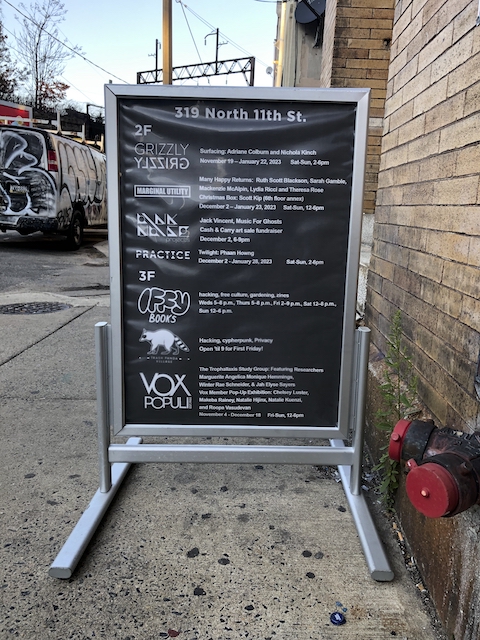
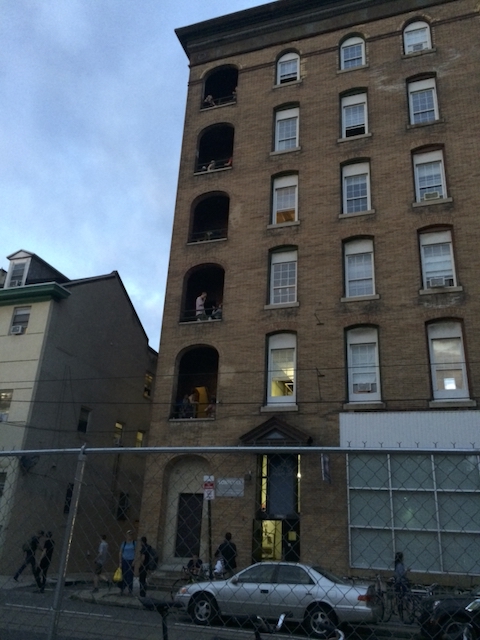
319 N. 11th Street, known as the Rollins Building, the ALCO Building, and the Vox Building, condenses over a century of urban labor and reuse into a single address. Built in 1937 on the site of Philadelphia’s garment industry, it later housed cigar manufacturing and novelty warehousing before becoming, in the early 2000s, a dense vertical network of artist run spaces and studios.

Over two decades, 319 was home to Vox Populi, Marginal Utility, Napoleon, Practice, Automat, Grizzly Grizzly, and Tiger Strikes Asteroid, among others. More than a shared location, it operated as an informal infrastructure shaped by overlapping relationships, shared resources, and a collective willingness to figure things out together. That structure persisted through a 2017 fire and ongoing real estate pressure in Callowhill and Chinatown North, not through institutional support, but through sustained collective commitment.

Produced by Marginal Utility and 2C Books for Collective Futures 2026, 319 is the first publication to assemble this history in print. Drawing on archival materials and firsthand accounts from past and present members of the building community, the project approaches the building not simply as a site, but as a working model. It examines the economic, social, and organizational conditions that enabled collective practices to endure over time, and asks what, if anything, from this history can be carried forward.